If you type for hours every day, your keyboard matters more than almost any other accessory. The wrong one leaves your fingers tired and your wrists aching; the right one fades into the background and lets you work. The first big choice is mechanical versus membrane, and the right answer depends on how you type, where you work, and what your hands prefer.
How the Two Types Actually Differ
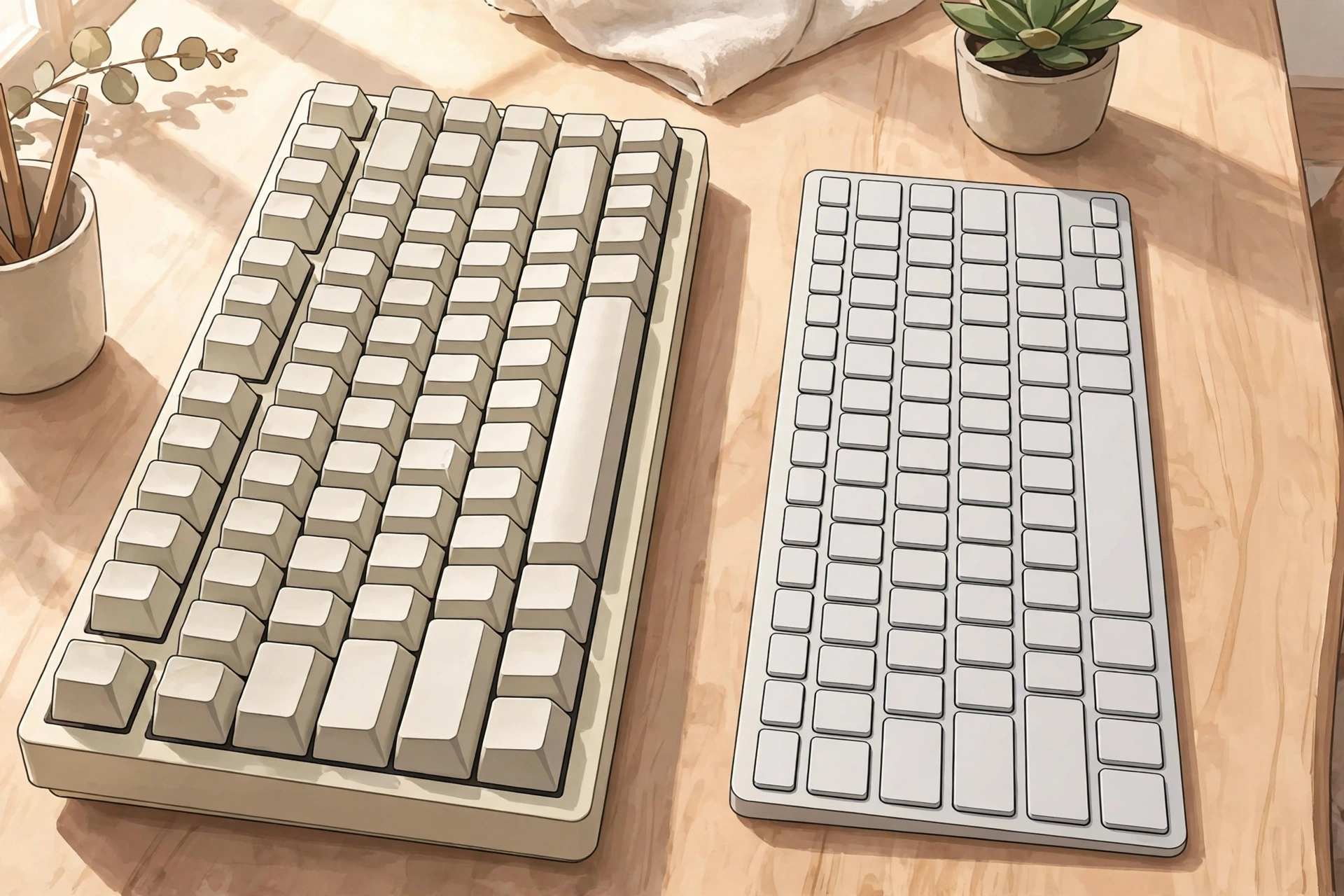
A membrane keyboard has a rubber dome under each key. Pressing a key squashes the dome until it touches a circuit layer and registers. The feel is soft and quiet, the keys sit low, and the whole board is thin and light. Most laptop keyboards and inexpensive desktop keyboards work this way.
A mechanical keyboard gives each key its own physical switch — a small mechanism with a spring and metal contacts. Pressing the key moves the switch through a precise point where it clicks or bumps into activation. Because each switch is separate, the feel is more consistent from key to key, and you can choose switches that match your taste: light and smooth, tactile with a bump, or clicky and loud.
What Matters When You Type All Day
Comfort comes first, and it is personal. Mechanical switches usually need less force to reach their activation point than a mushy membrane dome, which means less finger fatigue over a long session — but only if you pick a light switch. Heavy clicky switches can be more tiring than a good membrane board, so do not assume mechanical automatically means easier.
Noise is the second factor, and it is where membrane boards win outright. A membrane keyboard is quiet enough for any shared office. A clicky mechanical board can be heard across the room and will annoy colleagues on calls. If you want mechanical feel without the noise, look for linear or tactile switches described as quiet or silent, and consider a board with sound-dampening foam. Try before you buy if you can: a switch tester, a small board with one of each switch type, costs little and prevents an expensive mistake.
Durability is the third factor. Mechanical switches are typically rated for far more key presses than membrane domes, and on many mechanical boards you can replace a single worn switch or a set of keycaps instead of throwing the whole keyboard away. A membrane board that develops a dead key is usually done. Over several years of heavy typing, that repairability can make a mechanical board the cheaper option despite the higher upfront price.
Shape, Layout, and Ergonomics
Whatever switch type you choose, pay attention to layout. A full-size board includes a number pad; a tenkeyless board drops it and brings your mouse closer to your body, which many people find kinder on the shoulder. A compact board saves even more desk space but moves some keys behind function layers, which takes getting used to.
Also consider height and angle. A tall mechanical board often benefits from a wrist rest, and your wrists should stay roughly straight while typing, not bent upward. If you already get wrist or forearm discomfort, a split or tented ergonomic keyboard is worth trying before the pain becomes a real problem — switch type alone will not fix a posture issue.
Which One Should You Buy?
Choose a membrane keyboard if you work in a shared or quiet space, you travel with your keyboard, or you simply want something cheap, light, and good enough. A decent membrane board is perfectly comfortable for most people, and there is no shame in preferring a soft, quiet keystroke.
Choose a mechanical keyboard if you type for many hours a day, you want a precise and consistent feel, or you like the idea of replacing keycaps and switches instead of the whole board. Pick quiet or tactile switches for an office, save clicky switches for home, and buy from a shop with a good return policy so you can live with it for a week before committing.
Either way, the best keyboard is the one you stop noticing. If you can, test both types in a store for ten minutes each, typing real sentences rather than tapping a few keys. Your fingers will tell you more in those ten minutes than any specification sheet can.